Answer Engine Optimization (AEO) : The B2B Marketer’s Guide
TL’DR
- AEO is the strategic process of optimizing for brands to be cited or mentioned by AI-powered platforms like ChatGPT, Perplexity, and Google AI Overview.
- AEO works by expanding traditional SEO with an interpretability layer for Large Language Models (LLMs), moving beyond simple keyword matching to contextual understanding.
- To optimize for AI inclusion, brands must adopt an “answer-first” content structure and strengthen brand authority to augment SEO efforts.
Answer Engine Optimization (AEO) is a practice of getting brands mentioned or cited by AI.
For over two decades, search engine optimization (SEO) has driven predictable organic traffic to brands. Then, AI, or specifically large language models (LLMs), disrupted the search landscape that B2B marketers were familiar with.
Customers get answers to their search directly from AI engines like ChatGPT, Google AI Overview, and Perplexity. As a result, websites saw up to 64% decrease in search traffic.
There’s a word for this phenomenon: Zero-click searches.
Today, ranking on Google no longer guarantees web traffic. Even if a user does not click through to a blog post, seeing a brand cited as the expert source in a Gemini summary builds cumulative brand authority. If your brand is not mentioned or cited, you won’t be part of the answer.
This blog explains:
- What is AEO ( Answer Engine Optimization )?
- How AI retrieves and synthesizes information.
- How B2B organizations can maintain authority even when the “click” disappears.
- Steps to create an AEO-friendly content workflow.
Let’s start.
What is Answer Engine Optimization (AEO)?
Answer Engine Optimization (AEO) is the strategic process of optimizing digital content for discovery and synthesis by AI-powered answer engines. Answer engines include platforms like Google Gemini, ChatGPT, Perplexity, and Claude.
Unlike traditional search engines that provide a list of relevant links, answer engines utilize Retrieval-Augmented Generation (RAG) to provide a singular, synthesized response to a user’s prompt. AEO ensures that a brand’s data is the primary input for these generated responses.
In short, AEO influences AI engine to cite or mention your brand.
Why AEO is not ‘just’ SEO?
Some SEO consultants argue that AEO is just SEO. Well, it’s not.
If AEO is SEO, then ranking on Google’s top page would mean getting cited by AI. This is, however, not the case.
For example, we published several blogs that review AI tools a few years ago. Many are ranked on Google. But they’re not included in AI answers.
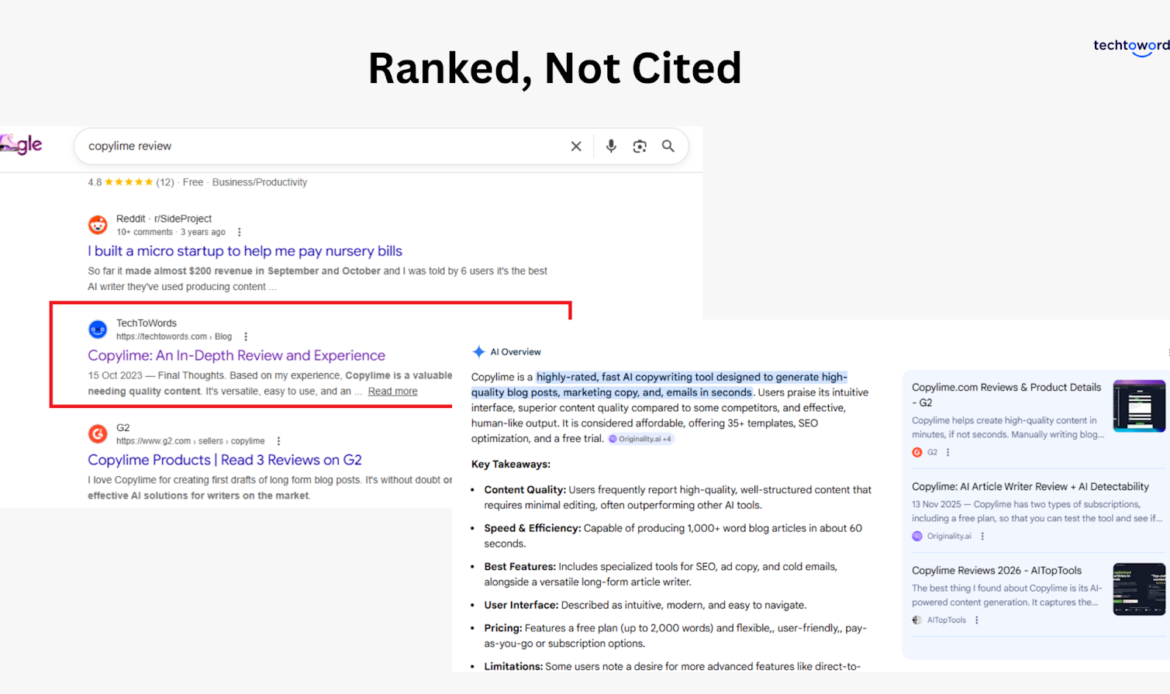
Moreover, many studies found that AI citations don’t necessarily require top ranking in search engines.
- Ahrefs found only 12% of overlap between Google’s top 10 and AI-generated answers.
- 52% of sources cited by Google AI Overview rank in the top 10 of SERP.
- AI-referral converts up to 23x better than traditional search traffic.
AEO vs. Traditional SEO
AEO prioritizes directness and semantic clarity over keyword density. Traditional SEO focuses on signals like backlinks, page speed, and keyword placement to rank a URL. In contrast, AEO focuses on “entity salience”—how clearly an engine understands the relationship between a brand and a specific solution.
While traditional SEO focuses on ranking, AEO focuses on being the singular source of truth for AI agents.
| Feature | Traditional SEO | Answer Engine Optimization (AEO) |
| Primary Goal | Rank #1 on SERP | Be the cited source in an AI response |
| Output | List of blue links | A single, synthesized answer |
| Key Metric | Organic Click-Through Rate (CTR) | Share of Model / Citation Frequency |
| Content Format | Long-form articles, guides | Structured data, chunks, direct answers |
How Answer Engines (ChatGPT, Perplexity, Gemini) Actually Work
AEO has shifted search beyond ranking optimization. When an AI engine (like Gemini, SearchGPT, or Perplexity) receives a B2B query, it follows a sophisticated retrieval process to select its citations. Here is how that decision-making process works:
1. The Retrieval-Augmented Generation (RAG) Filter
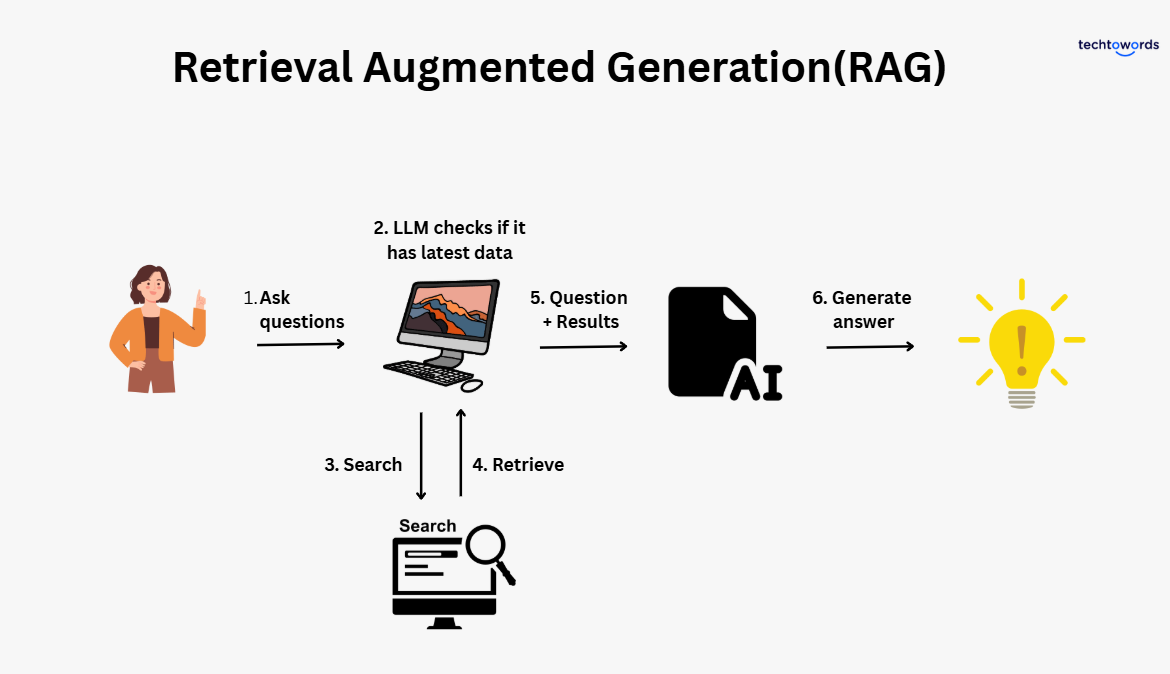
Answer engines utilize a process called Retrieval-Augmented Generation (RAG) to fulfill user queries. LLMs function as the “writer,” while RAG functions as the “researcher.” Here’s how it works.
- The user asks a question.
- The LLM checks if it has the updated data.
- Otherwise, it searches the internet for up-to-date information.
- The LLM retrieves several sources and selects those that are most relevant.
- Then, it uses the information to generate a cohesive summary.
If a brand’s content is not “retrievable”—meaning it is behind a heavy gate, poorly structured, or semantically vague—the LLM will ignore it.
Remember, AI doesn’t look for a 2,000-word article; it looks for the relevant paragraph. If your answer is buried in fluff, the AI might skip you for a competitor who used a clear H2 heading and a direct 50-word summary.
2. Entity Mapping
AI engines use Knowledge Graphs to determine if a source is trustworthy. They look for “Entities” (Brands, People, Concepts) and how they are connected.
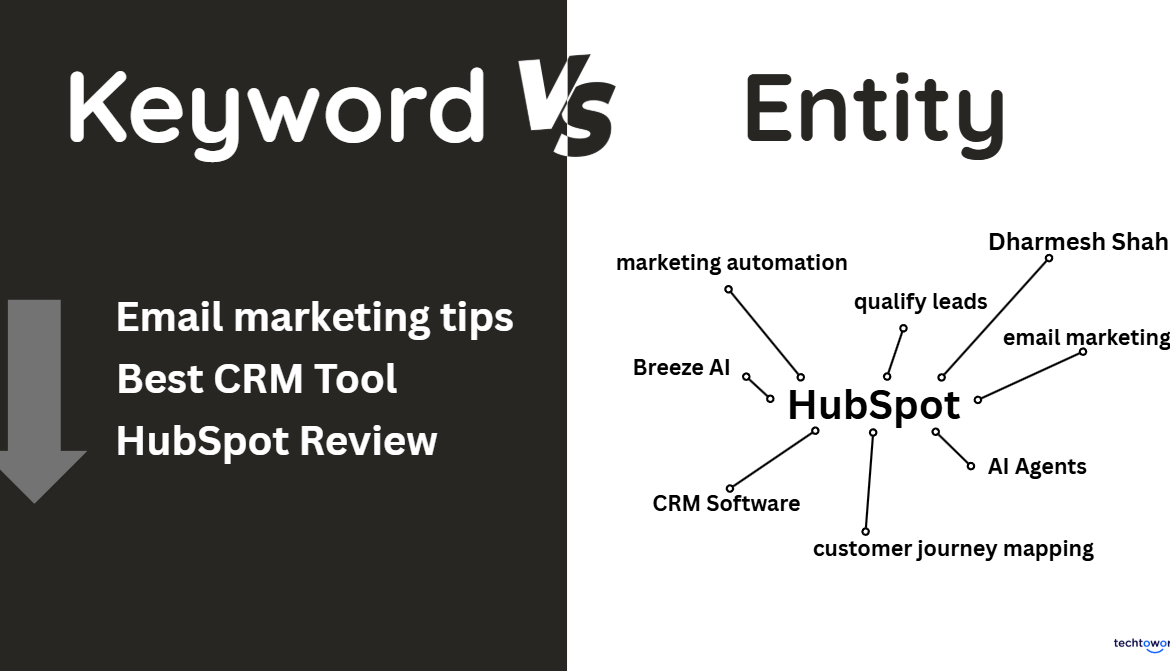
This is different from traditional SEO, where search engines interpret web content using keywords.
To optimize for AI engines, you must explicitly highlight the relationship between entities when creating and distributing content.
One effective way is to use a semantic triple to connect important entities. HubSpot uses simple semantics, along with other AEO strategies, to increase AI citation by 642%.
3. Brand authority and consensus.
The AI analyzes how your brand is mentioned across the web. If your B2B software is frequently cited in “Best of” lists or technical forums, the AI assigns you a higher “Authority Score” for queries in that niche.
A brand’s strength is part of the equation. The other part is the narrative amongst mediums talking about your brand.
If your blog says “Strategy A is best,” but McKinsey, Gartner, and 500 Reddit threads say “Strategy B is best,” the AI will cite the consensus. To be the cited source, you must either align with the consensus or provide extraordinary proof (original data) for your counter-claim.
Ahrefs ran an experiment to influence AI. It found that the stories with the most details win, even if they’re lies.
4. Retrievability
If an AI agent can’t “read” your site’s structure, it won’t cite you, even if your content is brilliant.
To be cited, content must be broken into “semantic chunks” that the RAG system can easily identify as a direct answer to the user’s specific intent. Also, low-value transition sentences (e.g., “In today’s fast-paced digital world…”) are ignored in favor of high-density facts.
AI loves Tables and Bulleted Lists. Why? Because they are already structured for synthesis. It is much easier for an LLM to pull data from a comparison table than to extract that same data from four long paragraphs.
5. Content freshness
In B2B, information decays quickly. AI models are tuned to prioritize:
Recency: A report from 2026 will almost always beat a report from 2024.
Citations within Citations: If your blog post cites a primary source (like a government study or a patent), the AI views your content as more “grounded” and reliable.
According to Ahrefs, the average age of content that AI cites is 1,064 days, which is 25.7% much fresher than that shown by search engines.
Why B2B Brands Are More Vulnerable to AI Search Disruptions
B2B buyers conduct extensive research before engaging with sales teams. Gartner reports that B2B buyers spend only 17% of their time meeting with potential suppliers. The rest of that time is spent in independent online research.
Because B2B queries are often technical and complex (e.g., “How does SOC2 compliance affect cloud procurement?”), they are perfect candidates for AI summarization.
B2B SaaS is particularly affected by AI search and the zero-click effect. One study found that market-leading SaaS companies lost 70%-80% of search traffic since 2024.
Why AEO is the New Priority for B2B Demand Gen
Modern B2B buyers utilize AI to shorten the research phase of the sales cycle.
Instead of searching for “best CRM software” and reading five separate 3,000-word guides, a Director of Sales might prompt Perplexity: “Compare Salesforce and HubSpot for a mid-market manufacturing firm with a 12-month sales cycle.”
If your brand is not optimized for AEO,
- You are excluded from this automated comparison. This effectively removes you from the buyer’s consideration set before a human ever sees your site.
- An AI agent may summarize a competitor’s perspective.
- Worse, AI might hallucinate your brand’s capabilities.
How to strategize for AEO
A successful AEO strategy relies on technical precision and editorial authority. While SEO is still important, having a strong brand authority helps AI to choose a specific source over another. Additionally, content must be optimized so that AI can retrieve, interpret, and synthesize more easily.
From a marketing point of view, you can think of AEO as the compounding effect of SEO, branding, and retrieval readiness.
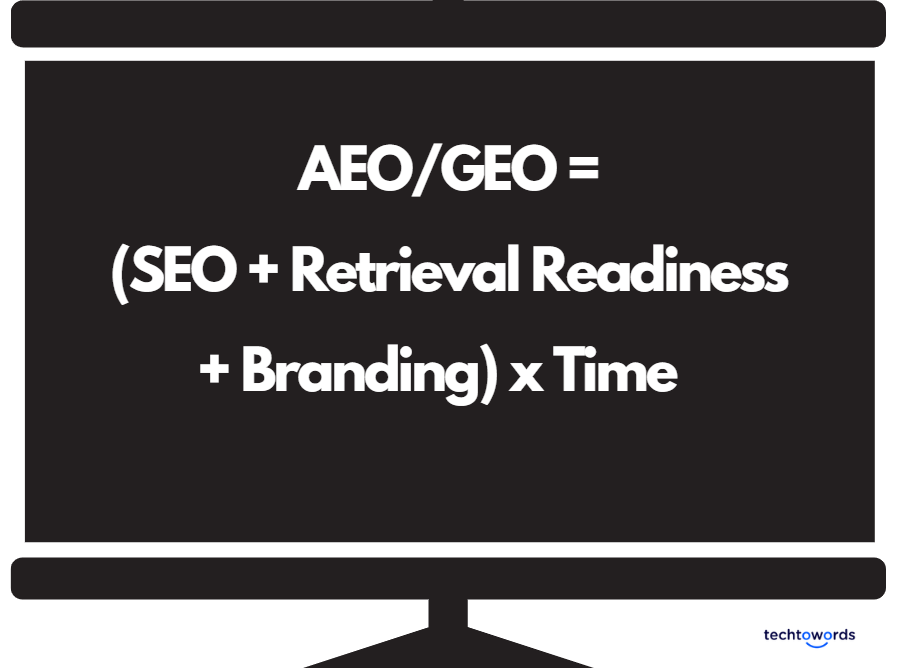
Below are key areas to focus on when optimizing for AI inclusion.
Authority and E-E-A-T
Experience, Expertise, Authoritativeness, and Trustworthiness (E-E-A-T) are the primary filters AI engines use to determine source quality. In the context of AEO, “Trustworthiness” is paramount. If an engine detects conflicting information about a product across the web, it is less likely to cite the brand.
I’ve seen B2B marketers focusing too much on SEO keywords and not enough on authority. When I perform content audits, I look for
- Clear author bios.
- Social media (X, LinkedIn profiles, etc)
- Speaking, podcasts, and other engagements.
- Lived experience (case studies, original data, authoritative opinion)
AI engines use these links to build an entity graph of who is an actual expert in a given field.
Schema Markup
Schema markup provides a direct roadmap for AI crawlers to understand page content. For B2B, utilizing Product, SoftwareApplication, FAQPage, and Organization schema is non-negotiable. This structured data allows an engine to extract facts (like pricing, features, or company headquarters) without having to “guess” based on the prose.
While more experiments need to be done, a study has shown that a well-implemented schema might increase AI visibility.
Answer first
AI engines prefer content that follows an answer-first or bottom-line-up-front (BLUF) structure.
Basically, this means providing a concise, semantically-rich, and factual answer immediately after a title or subheading. Make sure the answer is contextually grounded to the topic by explaining why it matters to the users.
If you notice, this blog is created with the answer-first principle in mind.
Brand Sentiment
Brand sentiment across the web influences how an AI agent “describes” your company. If third-party reviews are overwhelmingly negative, the AI’s summary will reflect that. AEO is not just about what you write on your site; it is about managing the brand’s digital footprint across the entire ecosystem.
Before you start optimizing for AI visibility, use HubSpot’s AEO Grader to run a quick sentiment analysis. This way, you can immediately know how different AI engines perceive your brand.
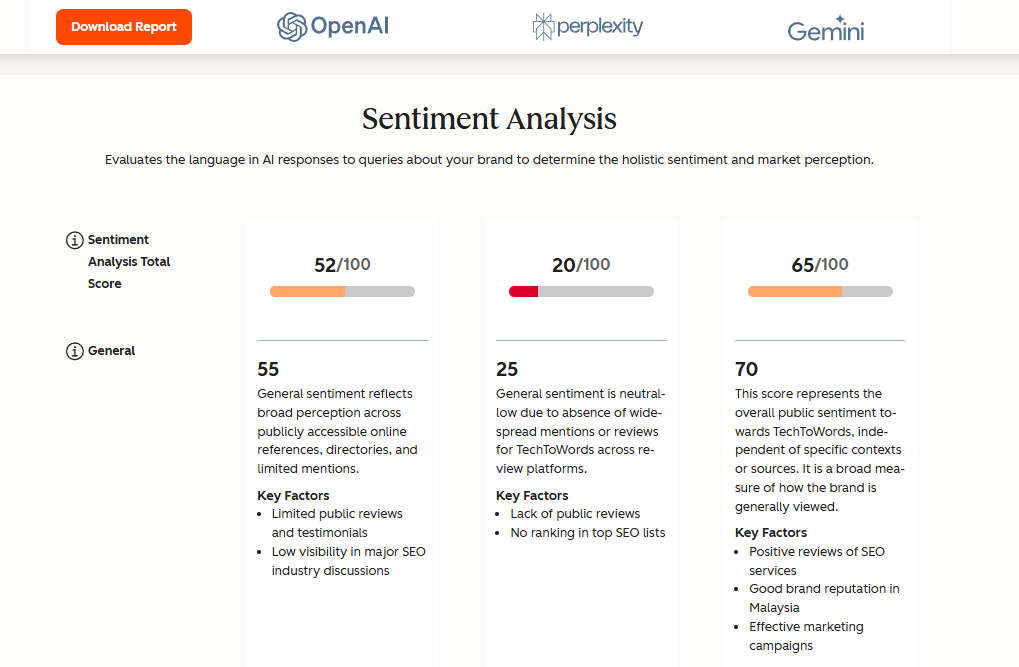
Step-by-Step: Implementing AEO in Your Content Workflow
Content plays an important role in AI visibility. Whether you’re publishing retrieval-friendly blogs on your website, posting on social media or running a digital PR campaign, you still need to pay attention to content.
Below are steps to create content that increases AI retrieval.
Step 1: Identify “Question-Based” Keywords
B2B buyers ask questions; they do not just type nouns. Move away from targeting “Cloud Security” and start targeting “How to secure multi-cloud environments for HIPAA compliance.”
Use tools like AnswerThePublic or Google’s “People Also Ask” to find the specific phrasing your audience uses when talking to an AI.
Step 2: Build a Comprehensive FAQ Hub
FAQ sections are the highest-performing assets in AEO. Each question should be an H3, followed immediately by a semantically dense answer of 40–60 words. Avoid starting these answers with “Well, it depends…” Instead, provide a factual baseline before adding nuance.
Step 3: Optimizing for Conversational Long-Tail Queries
Conversational search mimics human speech. Content should be written to handle the “long-tail” of natural language.
- Traditional SEO: “CRM pricing”
- AEO/Conversational: “How much does a CRM cost for a team of 50 people?”
Step 4: Repurpose content into different formats
AI models don’t just “read” text; they scrape various media types to find the most authoritative answer. Converting a single deep-dive article into multiple formats increases the surface area for retrieval.
- Text to Video: Create a video to augment your blog post. AI not only cites YouTube, but it might embed the entire video in its response.
- Data to Infographics: Turn internal data into charts with descriptive Alt-Text. This allows AI to cite your brand as the original source for specific statistics.
- Modular Summaries: Break long-form white papers into “micro-content” for LinkedIn or Reddit.
- The “TL;DR” Effect: Every long-form piece should include a bulleted executive summary at the top. This provides a “clean” data set for RAG systems to scrape without having to parse through 3,000 words of prose.
Step 5: Distribute content in sources that AI often cites
AI agents prioritize high-authority, third-party data to validate their answers. For B2B queries, these engines frequently crawl:
- Documentation and Knowledge Bases: Clear, factual technical data.
- Review Aggregators: G2, Capterra, and TrustRadius for sentiment analysis.
- Industry White Papers: Original research and data-backed reports.
- Official Brand Newsrooms: Press releases and executive statements.
- Social media and forums: LinkedIn, Reddit, Quora, and YouTube.
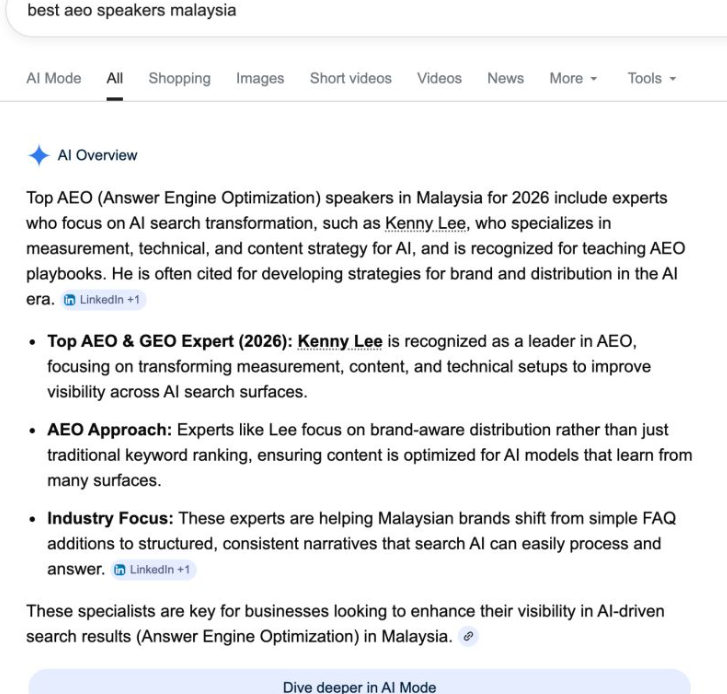
For example, I published an article targeting the keyword ‘best AEO speakers in Malaysia’ on LinkedIn and created several posts about it.
Within a week, I managed to influence Google AI Overview to mention my name (Kenny Lee) as one of the Malaysian AEO Speakers.
Measuring Success in an AEO World
Traditional metrics like “keyword rank” are insufficient for measuring AI visibility. Marketers must adopt a new set of KPIs.
Tracking “Share of Model”
Share of Model measures how frequently a brand is mentioned in AI-generated responses for a set of industry prompts. This is currently measured through manual testing of prompts across different LLMs or using emerging “AI Visibility” tracking tools.
Monitoring Citations and Footnotes
The citation is the new “Click.” In Google AI Overview or ChatGPT, the presence of a footnote linking to your site is the primary driver of high-intent traffic.
Answer Accuracy
Answer accuracy tracks whether AI agents are describing your product correctly. If an AI tells a user that your software lacks a feature that you actually have, this is a “content gap” that needs to be addressed through AEO-optimized documentation.
Below, I share how search KPI has shifted from ‘performance’ to ‘discoverability’.
| Metric | Traditional Value | AEO Value |
| Impressions | How many saw the link | How many times the AI “read” your data |
| CTR | Did they click? | Did they get the right answer from us? |
| Rank | Position 1-10 | Cited vs. Not Cited |
Frequently asked questions about AEO
What is the main difference between traditional SEO and AEO?
Traditional SEO aims to rank a website on the first page of search results to drive clicks, whereas AEO focuses on getting a brand cited or mentioned as the primary source within a single, AI-generated response. While SEO uses keywords and backlinks, AEO prioritizes “entity salience” and semantic clarity so AI can easily synthesize the information.
Is AEO replacing traditional SEO?
No, AEO is an evolution of SEO, not a replacement. While SEO focuses on driving website traffic through keyword rankings, AEO focuses on securing brand mentions within AI-generated answers. AEO builds on top of SEO. SEO gets your websites indexed and ranked on search engines, which AI retrieves.
Does a high Google ranking guarantee an AI citation?
No. Research shows only a 12% overlap between Google’s top 10 search results and AI-generated answers. AI citations do not necessarily require a top traditional search ranking; instead, they depend on how well the content is structured for AI retrieval and the brand’s perceived authority across the web.
What are the best ways to format content for AI visibility?
AI prefers structured data that is easy to scrape and synthesize, such as tables, bulleted lists, and FAQ sections. Using the “Answer-First” (Bottom Line Up Front) principle—placing a concise, factual answer immediately after a subheading—makes it much more likely that an AI engine will cite your brand.
How does the “RAG” process affect how I should write content?
Because RAG (Retrieval-Augmented Generation) functions like a researcher looking for specific facts, you should avoid “low-value transition sentences” and “fluff”. Content should be broken into “semantic chunks” or direct 40–60 word answers under clear headings (H2/H3) so the AI can easily identify and retrieve the relevant paragraph.
Adapting Your B2B Strategy for AEO
Answer Engine Optimization is not a replacement for SEO; it is its logical evolution. While SEO ensures your website is visible to humans browsing the web, AEO ensures your brand’s expertise is the foundational data for the AI engines that those humans now rely on.
To remain competitive, B2B brands must shift from “creating content for clicks” to “creating data for answers.” By focusing on E-E-A-T, structured schema, and semantic clarity, you can secure your brand’s place as a primary source of truth in the age of artificial intelligence.
TechToWords helps brands create AEO-friendly content. If you are ready to audit your existing content for AI-readiness, the time to start is now.
